freedom of the human spirit
I’m writing to you from North Carolina while attending the Grantmakers for Girls of Color Convening. It feels meaningful to be in the South at a moment like this. You may have seen the recent Louisiana v. Callais ruling, where the Supreme Court further weakened key protections in the Voting Rights Act of 1965 that were designed to protect fair political representation for Black communities. Since the decision, states across the country have moved quickly to redraw voting maps in ways that could weaken representation and reduce political power for Black communities.
Here are some of the immediate impacts of the decision:
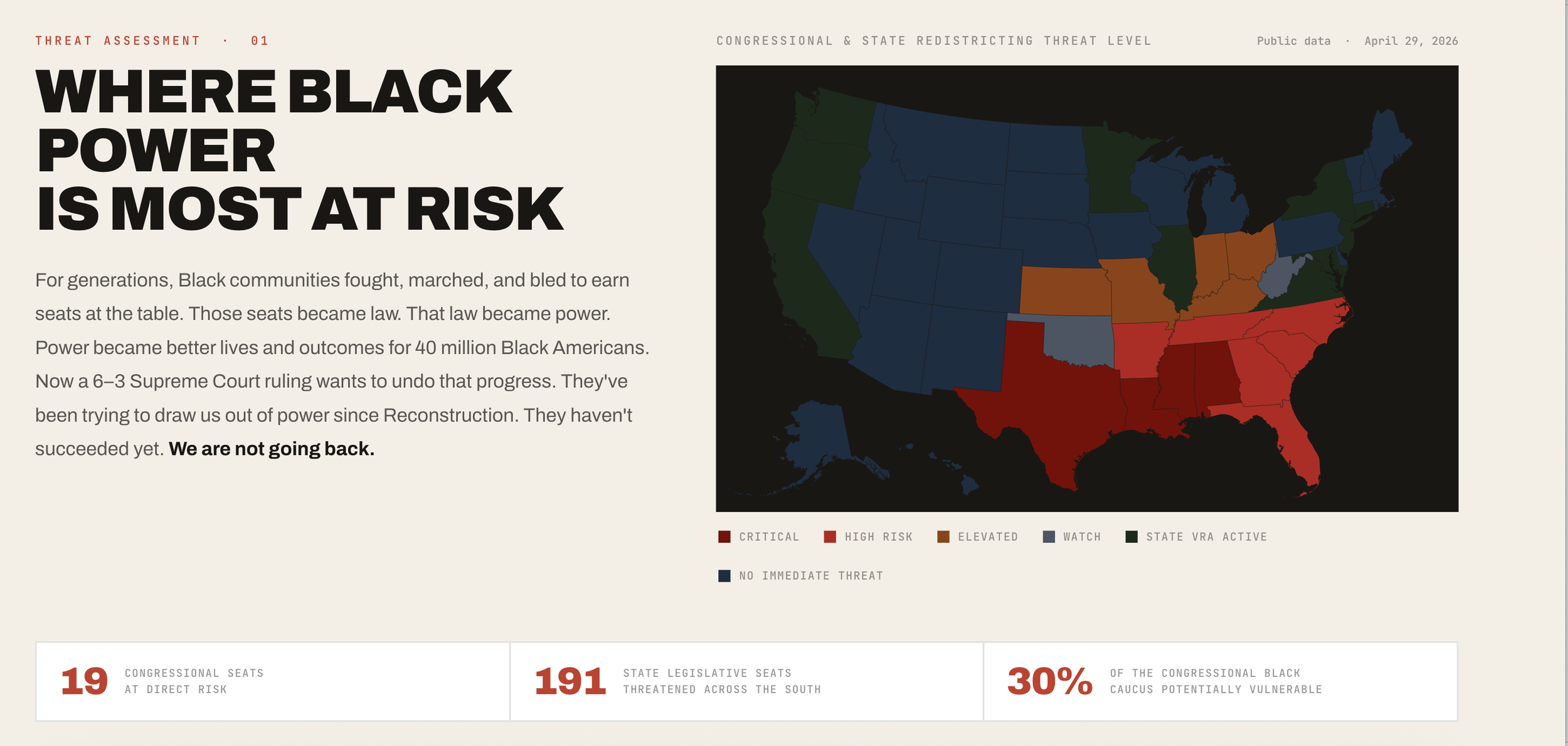
19 congressional seats are now considered at direct risk: This means millions of people could lose elected representatives who understand and advocate for the realities facing Black communities and other historically marginalized groups.
191 state legislative seats across the South are threatened: This matters because state legislators shape many of the policies that directly impact everyday life, including education, healthcare, reproductive rights, housing, policing, voting access, and public funding.
Nearly 30% of the Congressional Black Caucus could become vulnerable: This could significantly reduce Black representation and influence at the national level on issues ranging from civil rights to economic justice, while weakening one of the strongest collective voices advocating for inclusive democracy in Congress.
As Jamil Smith wrote in The Guardian:
“The gerrymandering will not stop at Congress. It will reach state legislatures, county commissions, school boards, every level of government where Black communities have built political power, district by district, since 1965. In the exact states where voting discrimination has been most historically violent, there may soon be no Black congressional representation at all.”
Leaders across the South are resisting engaging in tactics including economic pressure, political organizing, community action, culture, and faith. The South has always carried lessons for the rest of the country. American Civil Rights Movement leaders like Ella Baker taught us that durable change is built through institutions, relationships, political education, and everyday people believing they have the power to shape the future together. Through her work helping launch the Student Nonviolent Coordinating Committee (SNCC), founded right here in North Carolina, Ella believed communities closest to the struggle should lead the movement itself.
I’m proud that in 2024 Minnesota passed the Minnesota Voting Rights Act to strengthen protections against voter suppression and discriminatory districting, recognizing that protecting representation and participation cannot be left to the federal government alone. And yet, what’s happening still deeply impacts us. It is another weakening of our democracy and another reminder that the Midwest should not assume it is immune. As our very own Tonya Allen penned yesterday , “Detroit. Indianapolis. Chicago. Kansas City. St. Paul. Cleveland. These cities are also epicenters of Black life, Black leadership, and Black political power, and Northern states may well follow the same redistricting playbook. To assume otherwise may be our peril.”
It is urgent that we all understand there is a direct link between the freedom of Black people and the freedom of all people in our multiracial democracy. History has shown us time and time again that when the rights, representation, and political power of Black communities are weakened, the broader foundation of democracy weakens with it. And when Black people fight to move this country closer to its democratic ideals, everyone benefits from the expansion of freedom, participation, and justice. I keep returning to Ella Baker’s words: “Remember, we are not fighting for the freedom of the Negro alone, but for the freedom of the human spirit, a larger freedom that encompasses all.”
So what do we do?
Invest in Black institutions like ours as we invest in Black-led organizing. Give here to support our critical work across narrative change, grantmaking, leadership development, research, and more.
If you are able, support organizations in the South that are on the frontlines defending representation, participation, and democracy itself. We recommend Black Voters Matter.
Most importantly, tap in. Understand what is happening, talk about it with your communities, and help others make the connection between these attacks and our collective future. Read the articles linked in this email and check out this National Coordination Hub helpful tools.
Our hearts are in places like Alabama and across the South as communities gather this weekend for the 2026 National Day of Action for Voting Rights. The South has long been the testing ground for both the deepest attacks on democracy and some of the most transformative movements for freedom this country has ever seen. At this moment, we honor the leaders, organizers, faith communities, students, and everyday people continuing that legacy by fighting to protect representation, dignity, and the future of our multiracial democracy.
In Community,
Lulete Mola
President & Co-Founder
Black Collective Foundation MN